Score: score unavailable
Участник
Участник
0.000.00
Carlos is a hostage of the season calendar.
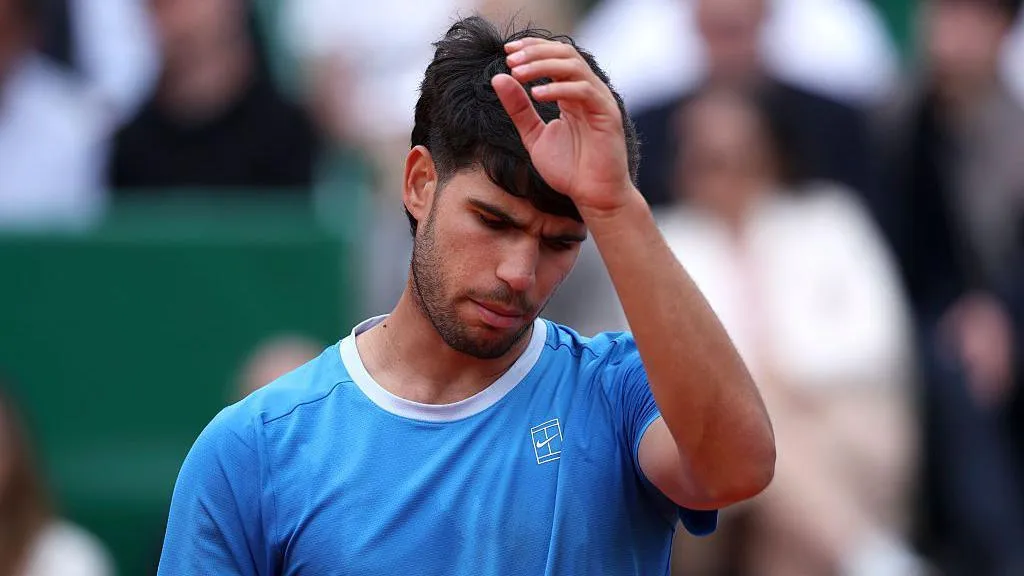
Alcaraz withdrew from the tournament in Barcelona after playing just one match, during which he called for the doctor. As recently as Sunday, Carlos was playing the Monte-Carlo final against Sinner; by Tuesday, he was already expected to appear before the Catalan crowd. Even Mirra Andreeva, who started in Stuttgart after winning the title in Linz, had her first-round match scheduled for Wednesday. An extra day of rest after a full previous week is never superfluous, but I do not think Alcaraz was not asked in Barcelona which of the two days he wanted to begin the tournament. Carlos seemed to understand: he was not going to get through a second straight week.
Last year, the Spaniard ended a similar two-week stretch with the title in Monaco and a defeat to Rune in the Barcelona final. A right-leg injury forced him to miss the Madrid Masters, which then paid off in the form of subsequent titles in Rome and Paris. This year, because of a right-hand injury, his appearance in the Catalan capital has been sacrificed.
For Alcaraz and his team, the clay season — or, more precisely, how to plan it — is becoming a puzzle with an asterisk. On one side of the scales are the Masters in Monte-Carlo and Rome: the first and last clay-court tests, where his main rival Sinner almost always plays. On the other side is the Barcelona–Madrid stretch, where home fans want to see Carlitos. He becomes hostage to the fact that, at the height of the clay season, two home tournaments are hanging over him at once. The Spaniard is the main favourite on any slow court, and if we assume that the aim is to win the four biggest tournaments of the European spring, that means five weeks without rest. You can make allowances for Madrid and Rome starting in the middle of the week, which in some sense gives a breather, but it is still a requirement to keep yourself in competitive mode.
Clay king Rafael Nadal, who won 63 titles on his favourite surface, swept the full set of three clay-court Masters only once, in 2010. His desire to prove that the previous year’s broken hegemony in Paris was an accident was off the scale, but even Rafa had to sacrifice Barcelona along the way to recover his strength. And back then, the calendar for top players looked slightly more compact, given the one-week format of the Masters. This topic was interestingly broken down by Yevgeny Kafelnikov, Elena Dementieva and Svetlana Kuznetsova in the new episode of Hardcourt, where they weighed the pros and cons of extending the duration of 1000-level events.
At this stage, Alcaraz simply needs recovery and quiet, with the caveat that the injury is not too serious. Five weeks without rest on the most physically demanding surface is too much even for him. You can make as many calculations as you like around the Masters, which this season have so far been collected exclusively by Sinner, but for both of them it is more important to peak by the start of summer. As for Carlos, sometimes he simply needs to spend a little time at his family home in Murcia or in Ibiza, not pick up a racket for a couple of days, and then the result usually does not take long to follow.