Score: score unavailable
Участник
Участник
0.000.00
What supremacy does Yannick have over the res of tennis tour.
Jannik Sinner completed the Sunshine Double with effortless authority, becoming the eighth player in history to win the Indian Wells–Miami combination in the same year. At the same time, the Italian is the only one to have taken the first two Masters events of the season in America without dropping a set. And given that he followed the same script in Paris last autumn, he has now gone three consecutive 1000-level tournaments with no one able to match him. So what exactly makes Jannik superior to everyone else on hard courts?
Beyond the fact that Sinner has been the best player of the past 52 weeks in the fundamental forehand and backhand metrics, his total dominance is now underpinned by a major improvement on serve. Across the entire Miami tournament, more than half of Jannik’s serves — 52% — went unreturned. The most impressive first-serve stretch came at the end of the second set in his semi-final against Zverev. Sascha, who was playing at 9 out of 10 by performance rating, ran straight into an opponent who made 16 of 16 first serves. And although that match was far tighter than their meeting at the same stage in Indian Wells, the German was still helpless against Sinner in the decisive passages.
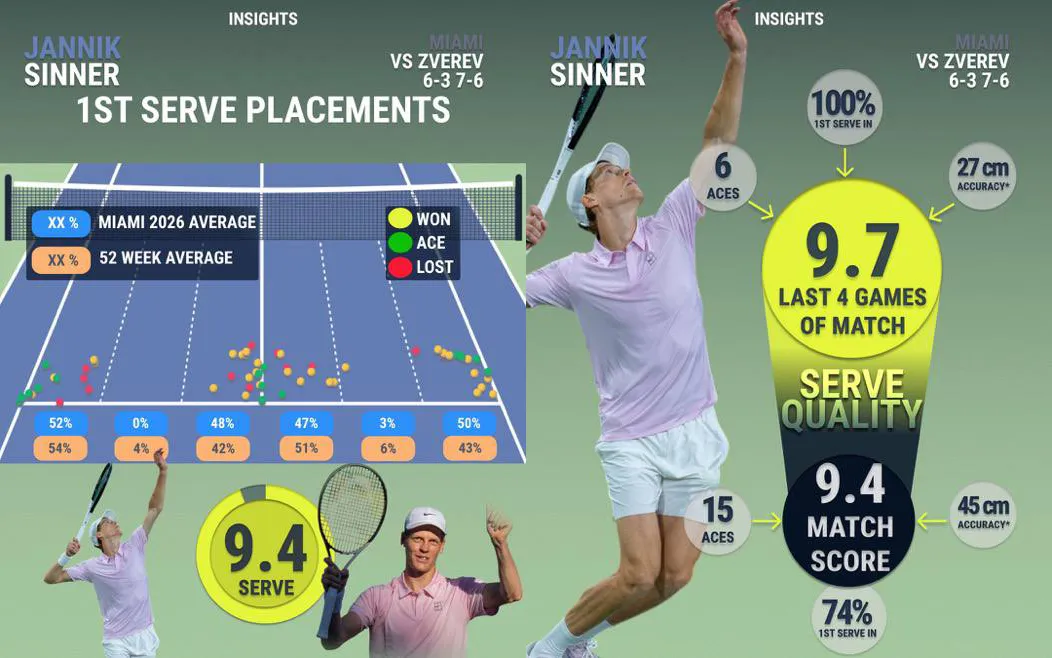
In terms of first-serve points won at a single Masters event, Jannik set a new personal best — 86.21% — improving on the mark he had posted in California two weeks earlier: 85.65%. In the entire history of Masters tournaments, he trails only the trio of Ivanisevic, Krajicek and Becker. In the 21st century, no one has served more efficiently than Sinner. The Italian’s elite numbers are best compared with his own version from last season: his serve accuracy and conversion are 2–3 percentage points higher, his unreturned-serve rate is up by 2 points, and his average serve speed is 4 km/h faster. Those 2–4% may seem marginal at first glance, but they become crushing when set against the tour averages, which Jannik now exceeds by around ten percentage points.
Even more striking is how close to the service-box lines he places the ball. Sinner almost never goes into the body; he plays either down the line or out wide. On average, the Italian’s serve lands 45 cm from the line, compared with 60 cm across the tour. That figure becomes even more startling when you see 27 cm during the decisive stretch of the already mentioned match against world No. 4 Zverev. Jannik’s serve quality in the biggest matches is now consistently climbing above nine.
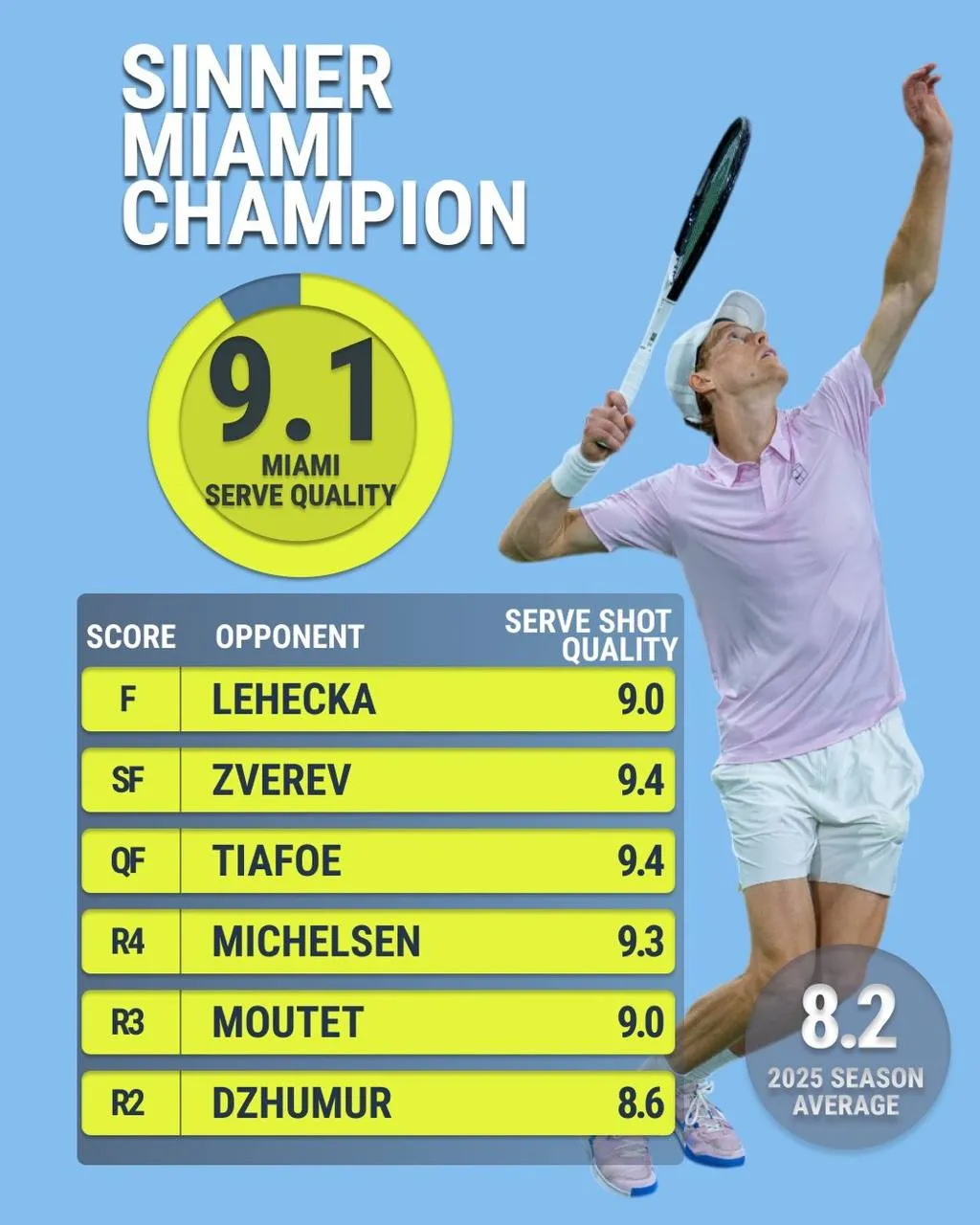
Sinner completed hard-court tennis two weeks ago, when he won the one major title on the surface still missing from his résumé. But his goals this season are tied to clay, where, by default, life is hardest for him. Now, the tiny technical details — and the serve certainly belongs among them — need to be backed up by extraordinary physical conditioning. After all, he still does not have a single match win lasting longer than 3 hours and 48 minutes. Then again, with a serve like this, he may not need to get anywhere near that mark at all.