Match Center
Back to videos

First&Tour: Alexander Bublik

First&Tour

On the first episode of First&Tour Anna Chakvetadze recalls her performances at the Australian Open and talks to Alexander Bublik
Duration
Family friendly
Yes

Transcript

Friends, after a long break First&Red is back, and the tennis season is back with it. Behind me is Flinders Street Station, Melbourne's famous landmark. And very soon one of the biggest tournaments of the season kicks off — the Australian Open. First&Red will, of course, be preparing the most exclusive content for our beloved subscribers. Subscribe to our channel, hit like, and let's go! We're at Hosier Lane, a small alley in the center of Melbourne that has long since become a symbol of the city's street art. These walls get a new mural of the Australian Open champions every year. Back in '22, for example, there was a mural here of Australian Open winners Kyrgios and Kokkinakis. I wonder who we'll see here in a couple of weeks? First of all, I haven't been to the Australian Open in 13 years, dear friends. And my best season was in 2007 — that's 20 years ago. How well have I held up? I think so, okay. Write in the comments. Listen, it's a really long trip out here, and huge thanks to the First&Red team — without them I probably wouldn't have made it here. But I did have a little success here. I played in a challenger, again back in 2007, and lost to Masha Sharapova. It was a good match. I remember it like it was yesterday — that forehand that flew straight out of the court into the fence. And that was it — we flew home. Well, Masha played really well. Playing in Australia in general isn't easy, because you usually prepare — well, I prepared personally — before the Australian, but somewhere in a gym, in Moscow, in the snow, and then you have to fly here, where it's plus 30 and sunny. Actually, once I had a pretty serious temperature swing — I flew from plus 30 straight into minus 30. And on top of that you have to stay in shape. So it wasn't easy, but tennis players, you know, they get used to everything. You probably don't know this — or maybe some of you do — that Australians don't just love tennis, they also love Australian rules football and cricket. Right across from the big Australian Open stadium there's a small football ground. I had a photo session there with some footballers. They told me, quite sadly, that unfortunately football isn't very popular here — everyone only watches tennis and Aussie rules football, and they're kind of left in the shadows. So I kicked the ball around a bit, showed off my skills, and honestly, they probably could have taken me onto the team — that's roughly the level we're talking about here. Haven't subscribed yet? Make sure you do. Throughout the whole tournament we'll be giving away exclusive prizes on our Telegram channel. Don't miss out, friends — be sure to subscribe to our Telegram channel. Boris Becker said two months ago that Bublik would definitely be in the top 10. At the time you were eleventh. How do you generally feel about predictions like that when they seem so obvious? I wouldn't call it an obvious prediction — you can lose ten matches in a row just as easily, and I've proven that year after year, that anything is possible in either direction: you can drop from 17th to 80th just as easily as you can climb from 80th to 10th. So no — it's nice, in any case, that Boris Becker — I'll explain, we don't have the warmest relationship — speaks so flatteringly about me, aside from my ranking too. Of course that's nice for me. We did an interview together seven months ago. Back then you said it would be interesting to get a taste of the top 10, but that you didn't want to spend three years of your life chasing it without fulfilling yourself. In a year everything changed — you went from 70th to 10th. So what actually changed, apart from the ranking? Globally, nothing. If we're being honest, essentially nothing changed. What changed, I suppose, is that — when you're ranked 80, you realize that, generally speaking, on the whole, there isn't really that much difference — in my understanding, in the level of play — like, 80 is a terrible player and 10 is a wonderful one. To me the difference is in how much more responsibly I've started treating important points, so to speak, and having a strong desire to play very few tournaments and be home very often. That moment came for me when I was ranked 80 and I realized that to earn, say, a thousand points, I'd need to play 10-12 tournaments. And then things started clicking, and I thought: what if I play four tournaments and still manage to earn that same thousand points? That's better, right? But for that you have to be much more responsible about what you're doing. Today we were driving in the car with Artem — yesterday we sat down and played some casino games, I just came from there, stood around for a bit, and honestly I started to feel kind of off, and thought I'd rather go rest. And that feeling has started showing up more — that I've started treating tennis travel, going to tournaments, all these competitions, more and more like work. Like, I've come here, I'm not having fun, I don't enjoy it — like right now, talking with you, I'd rather be lying at home. I mean, talking to you is nice, of course, but lying at home is still better. Resting, I mean. So it's become like I've come to work. I don't get any real enjoyment out of the city, or the flights, or any of that stuff. For me it's just: I've arrived, I have a tennis match, and I have to win it — by any means available, within reason, of course, nothing dirty, nothing like that. And I think that's what's really changed in me — I've developed this strong, genuine desire to finish a given week as fast as possible, finish it well, and leave and forget about it. And then to be able to say, okay, I won Hong Kong, I'll play well here, and I can allow myself to skip two or three weeks after. Because, roughly speaking, the ranking I have now suits me. I understand I could climb higher, but then again — for what, and for whose sake? So I think that was the real turning point for me — I started holding on to competitions more tightly, precisely because I want to spend more time at home. I really love my life in St. Petersburg and in Monaco. I treat it with real tenderness. Being home matters a lot to me. That's probably the main thing. Back then you also said that if you fell out of the top 100, you'd retire. Would you really have quit? Well, "retire" was probably something I said in the heat of the moment. But of course — look, what is tennis? Tennis is a way of making money. Either you make money plus accolades — titles, status, and so on — or you just make money. But wait, if you fall out of the top 100, if you're 110, you're still earning something, you're still coming out slightly ahead. Well, who cares about that? You wouldn't be willing to keep going for that? For some conditional amount of money, no, I wouldn't keep flying around to places like Australia just for that. But I understood — first of all, I already had fairly serious contracts by that point. I understood that even sitting outside the top hundreds, I'd still make more than some decent sum, even if I stopped playing globally altogether. I could play five tournaments a year, ten tournaments a year, and I'd still be making decent money. So I think "ending my career" was said somewhat in the heat of the moment, but what I really mean by ending a career is having no desire, no emotional drive to compete and to try to achieve something. If you break it down, I hadn't really quit, because I have five-, six-year contracts with each of my brands, and there's nothing they can really do about it in terms of the reductions — those had all already kicked in once you drop out of the top 100. You end up earning less than you did at 20th, because I signed those contracts back when I was ranked 17, 18, in 2024. So I understood I'd still be earning decently, still playing some exhibitions here and there. I could manage that, right? Tell me — how do you feel as a top-10 player? Has anything changed? Thank God, nothing has changed. That's really important to me. Honestly, back when I hadn't reached it yet — I was eleventh — whenever we trained, we set that as a goal and thought about how to get there. I never thought, you know, roughly speaking, that guys like Danny or Casper or Draper behind me would just stop playing well and I'd somehow slip into the top 10 on pure luck, going from 11 to 10 off old results. We didn't really believe in that, and I think that was the right approach — that we went into this season's preparation trying to change my game, become more aggressive, and try to actually win something. And I honestly didn't expect to win the very first week. I flew out here thinking it would be nice to win something, just once, in the opening week — because in my entire life I've only ever reached one final in the first week. Everything else I always lost, everywhere. I hold a record here — out of ten Australian Opens, I've won three matches total. I've always started really poorly here. And when we did win, honestly, I can't say I felt anything extraordinary. Like, good for me, I won, okay, I'm now ranked tenth, great. And that was basically it. We shook hands, said, "guys, we did it." I called my wife, said, "that's it, we did it." And that was that. And then there are already other goals, because if you stop there, you might as well hang up your racket tomorrow. Interesting — so you're not planning to stop at 10? Great — I know you're going to argue with me now. Let's think about this. You beat Musetti in the Hong Kong final. He's in the top 5 without a single title. Does that mean you could be top 5 too? Well, you're a tennis player yourself — you understand that if Vasya beats Petya, and Petya beats Dima, that doesn't mean Vasya beats Dima, right? The point is I currently have around three thousand-something points. Look, those don't expire before Roland Garros, essentially, right? No, I mean — it doesn't matter, there's no such thing as points "expiring" — there's only "accumulating" points. I need to earn another three thousand points, even more — I need four thousand more to be top 5. That's probably where the real work is. So when we talk about not stopping at 10, it doesn't mean I don't want to become ninth, or eighth, or seventh, or fifth. It just means you have to keep playing tennis and try to play it well, because we're all trying, right? I just started winning — I was ranked around eight. How many guys were around me who are also trying, and, roughly speaking, maybe someone's dream is the top 10, someone else's dream is winning a Grand Slam — I don't know what their dreams are. But that's how it worked out for me. So my goal this year is to confirm what I did last year. Maybe improve a little? Well, if I could improve, you know, then we'd already be talking about something great — Guys, guys, take a screenshot — in a few months Sasha Bublik, top 5. Sasha, if you make top 5, will you send our team some chocolates? I'll send them. Deal. Sasha, ATP made a film about you, and in it your physio said Sasha claims results aren't the main thing for him, but it's more a way of taking the pressure off himself. No, what he said was — he cares more than he lets on. It's about staying a sane person over such a long stretch, ten years into a career, fifteen years into a career. I think that's basically impossible. So yes, he's partly right, of course. I say that openly myself. What else do you do to add pressure on yourself? Honestly, probably nothing. I can't really say. For me it's simply that there needs to be a distance between me, the ordinary person, and me, the tennis player — even a distance between me and myself. I'm not even talking about distance from other people. I never let anyone into my inner circle. It's almost impossible — you could say it's basically impossible — to get in there if we don't already know you and you don't already know us. I don't do buddy-buddy stuff with anyone, don't try to force my way into friendships, or the other way around. For me, that wall — especially with the people I work with, especially with people who are, in some sense, tennis lovers, tennis fans, my fans, or fans of sport in general — there always has to be some distance, otherwise you end up absorbing all of it. Why take on negative energy from people? And what if it's positive? Not many people actually have positive energy. Mostly people are envious somewhere deep down, or they're happy about your losses. Some are happy about your wins too, good for them — but I mean, how am I supposed to figure out who's who? Why would I even need to figure that out? I don't need that. There's a basic level of interacting with people, and you keep that distance and treat everyone respectfully, but at the same time you don't let anyone in, and especially you don't let in the negativity you see in the stands, on social media. It's there regardless. It has to bounce off you, and then it's much easier, much saner, to keep moving forward and to play for a long time — at least staying mentally healthy. I'm not saying playing well, but at least being mentally healthy, for sure. Were there any interesting new acquaintances last year? Well, you saw the photos — for example, Igor Vernik, we hit it off great, had a wonderful time talking with him. Danila Sharap, for instance, our big producer friend too. All of that really kicked off when we started collaborating with Sergei Sergeyevich Minaev. Tell us about that collaboration — how did it start? It all started with our podcast "Tea with Bublik." There was interest from my side — Sergei Sergeyevich and I had been exchanging a certain amount of respect on social media. He was probably the first person that came to mind when we wanted to do a podcast. I said, I want it to be Sergei Sergeyevich. I was too shy to write to him directly about it and asked the First&Red team to handle it. He very kindly agreed. And from that point on we somehow started talking. And honestly, we found some kind of — not exactly a working relationship, more of a mutually rewarding, human one, in a way. Our wives became very close friends. So overall we developed a genuine friendship, which is, I guess, kind of unusual between a 28-year-old kid and a 50-year-old man. It's a bit unusual, I suppose, but it worked out just fine — we had a great time together. And then, after our photo with Vanya Yankovsky and Sergei Sergeyevich, we read a lot of comments about, you know, "collabs" and all that. And we were in Korea — this was after the Davis Cup, before I flew to Hangzhou — and, as fate would have it, Sergei Sergeyevich writes to me, "Sasha, I've got this offer, give me your agent's number so he can sort it out." I said, I don't have an agent in Russia — nobody handles my affairs in Russia specifically. And that's how the conversation started, and somehow — he wasn't really pitching anything — I said, listen, since you're offering me all this, why don't we come up with something interesting together ourselves? So it was your idea? Yes, it was — it was kind of like, you know, I tell you, "hey, do this," you say, "I can't, I don't have that," and I say, "well, I do — so let's do it." And on that friendly wave we decided we'd do something cool, something fun, something that might even be useful for people. So it's more of a friendly collaboration that everyone had been asking for. When we announced it, that's exactly what people had been writing about — "there you go, two cool guys sitting and chatting on a podcast." And basically, I was also filmed for Chtivo magazine, he came on my podcast, I went to the premiere of "Zolotoye Dno" — when he had the "Zolotoye Dno 2" premiere in Moscow. And it all came together like that, in a friendly way — it's not, you know, some commercial partnership that — If he's not getting anything commercial out of it — Well, if something comes of it, sure, because we're both involved in business projects too, but I mean it's really more about the human side — that we're comfortable together, we get along really well, and it's fun and interesting to try to achieve something together. And if we don't achieve anything, no big deal, we'll just keep enjoying each other's company. You also posted photos from taking the family to see "The Nutcracker" — watched it all the way through, didn't fall asleep? I love it, why would I fall asleep, it's wonderful. It's just that sometimes it can be a bit much for guys. No, I love it — we actually had a really cultural off-season program. First we went to see "The Cherry Orchard" — Vanya Yankovsky invited us, we sat through the whole thing, it went on quite a while, an hour and a half, intermission, another hour and a half for "The Cherry Orchard." And then we went to St. Petersburg and went to the Mariinsky Theatre. No, it was great, honestly, I really enjoyed it, no complaints at all. Cool. Continuing the off-season theme — what else interesting did you get up to? Drinking in St. Petersburg? Well, of course, I mean, what else would I do? Aren't you supposed to be all about the healthy lifestyle? I don't see any contradiction there at all. How do you drink, then? With pleasure. So in the off-season it's fine, but during tournaments? If I feel like it, I don't see anything wrong with having a glass of beer or a glass of wine — I don't see any issue with that at all. If anything, it relaxes you, and if it puts you in a good mood, you should do it. So, in my view, I had a wonderful off-season — I spent two amazing months in St. Petersburg, had a great time meeting a huge number of old friends and new friends, a huge number of people we love. It was honestly one of the best — probably the best two months I've had in a long time. Because you were home. Home, yeah, and everything just came together well. We trained, worked, and rested well. So overall we did it all — training, and a proper cultural program too. It was a great time, and the holidays were wonderful too. You said something changed in your preparation, that you tried training a more aggressive style of tennis. Why did you decide you needed to play even more aggressively? Well, I think — I've trained this way my whole life, or at least since I became aware of it, since Artem and I started working together — that you need to look at how the top of the rankings plays. If the top guys are hitting through the ball and you're just standing there feeding it back, you're probably doing something wrong, in my understanding. But you weren't just feeding it back like that. Well, I tried, I tried to understand that you need to play attacking tennis, take the ball earlier — you look at the best players and see what you can take from that for yourself. I'm completely open about this, there's nothing awkward for me in saying that I can quite calmly watch how, say, Sinner plays, or how Alcaraz plays, or how Danny Medvedev plays, or Sasha Zverev — because I understand that if they're at the top now — say, back when Danny was at the top — I'd think, okay, if this is the tennis that's winning for him, maybe I can take something from it and try it. Sometimes, no, I can't, because of this, that, and the other. Can I take something from Zverev? Maybe just one element. But if that one element helps me even a little, why not? So the way I see it — we looked at the stats, on my return game, for instance, where I was falling short. And basically the entire preseason preparation was built around improving my return, playing more attentively from the baseline. We almost didn't serve at all during the preseason — I barely served the whole time. Mostly we worked on combinations off the return, combinations off defense — we tried to improve the defensive game and tried to work more on transitioning from defense into attack sooner. Because, I mean, you don't need a PhD to understand how the top players play these days — you look at it and ask yourself, can I do that? Say I can manage 20 percent of it — that 20 percent needs to get folded into my game, I try to make it work. I can't just decide I want to play like Sinner and start playing that way. But if I can take even 2 percent from him, and it helps me improve, helps me win that one point, or that rally, or that game that I wasn't winning last year, that could let me win a match I wouldn't have won, and maybe that leads to something bigger. A lot of people say you could still add a lot in terms of physical conditioning. What do you say to that? For that you'd need to train a lot. But you have been training, you said so. No, I have been training — I actually explained this really well in my last interview, because I train in a way that lets me keep improving. Basically, minimum effort, maximum result. Wait, how many hours of tennis do you do, how much physical conditioning? Let's be specific. None, I don't know. You don't do any physical conditioning? Well, look, let me tell you — let's just take the preseason preparation I just went through. For example. The first block — I remember it well because I was wearing a tracker, you see, that's already progress, I wanted to track it. We wanted to understand how many hours we were putting in. So basically the initial plan was: eleven o'clock, break, like 20, 30 minutes of some running-based fitness, some light cardio, and then, say, from five to six-thirty. Probably the hardest day I had was three hours of tennis — two and a half hours of tennis plus 30 minutes of fitness. And that was the preseason. How much do you think Alcaraz and Sinner train? I don't know. I'd guess more, of course. Especially since they're younger. They are younger. Like, they're what, five years younger than me? So of course their bodies can handle more. Fitness ends up on the back burner for me. I mean, what do you even mean by "fitness"? If it's fitness in the sense of lifting weights, trying to get bigger and stronger — I never do that, I have basically no fitness routine like that. I can do a deadlift, more or less, I understand what that is. I've touched a barbell maybe five times in my entire life. No joke. I've picked up dumbbells maybe ten times in my whole life. I'd rather play for 15 years and be ranked 30th than play for 7 years and be ranked 5th. You don't know exactly where the body's limit is — where, say, you do two two-hour sessions plus fitness, and the next day something hurts, and is that improvement, or is that the pain right before something tears? I don't even want to guess at that. Do you feel better in a best-of-three format or best-of-five? Best-of-three, of course, probably. Five sets isn't always — you know, look, what is a best-of-five match? Five sets at Roland Garros in 20 degrees is one thing. Five sets in Australia in 40 degrees is a completely different thing. So, I mean — I'm not going to force myself. The problem in Australia, in America, is always that I can't, I don't want to play in 35-degree heat. I don't see any point in it. But you can't just skip it, can you? What do you mean? Can I? Well, I can just choose not to play at full intensity. Well, you've already arrived, that's that. No, right now everything's fine, the weather's fine right now, I'm speaking generally. I just don't see the point in it. There's no — well, imagine, I've come to a tournament, right? I know how to do the math, right — I understand, okay, I win this match, or two or three matches, here's how much money I'll make, here's how much I'll pay the team, here's how much I'll have spent, and so on. And when I realize it's 36 degrees out, I understand that to win that match I'd have to bury myself completely to get it — and there's still no guarantee I'd win. And I figure, okay, I win one match, and the next day I can't even get up, because it's 40 degrees. I honestly don't even think it's right to play in that kind of weather. We're human, after all. Basketball players don't play in that kind of heat, hockey players always have the same conditions. I don't see the point in torturing my heart just to win a match and make some money, when I know that afterward I won't be able to get up, I won't be able to travel, I won't be able to play anything — and that could put me out for three whole months. So I've said, look, guys, thanks, but no. And it's not just me — my whole team feels the same way. If a coach tells me, "go play in 35 degrees," I say, "you go play in it if you want." I just don't see how that contradicts being a professional athlete. Do you get upset when you end up in the red financially at tournaments? I don't think I've ever been in the red. How could you even go negative at a tournament? Well, for instance, when you were ranked 80th and playing Challengers, you probably spent more than you earned. I played two Challengers. I made the final in one and won it. No, but how — no. So you're always in the black, you've never really thought about it that way? No, how — I honestly don't understand how you could end up in the red. Let's actually philosophize about this for a second, let's debate it. If you lose in the first round, you still have to pay your team, your flight — Wait, you mean if I go to a 250 and lose in the first round? Well, you don't go to a 250 just for the money — you understand that you're going for other reasons. For me, "in the red" isn't measured week by week — I think in months, in quarters. Going negative, at this level, is basically impossible. So it's never — for me, first of all, I love money, I respect money, but it's never been the single, sole goal for me, where I'd do absolutely anything for money. That's just never been the case, and I'm grateful for that — I know roughly how much money I need to maintain my standard of living. And I know I can afford to say no to certain tournaments sometimes, skip certain exhibitions or other commitments, simply because I don't feel like it. But you still play because you love tennis, right? Of course, it goes without saying that I love tennis, I've always said that. But sitting in Australia in 40-degree heat, of course, I don't enjoy that. But it's necessary sometimes — I do say the word "necessary." Like in real love, there are ups and downs, right? Right. Did you watch the match between Aryna and Nick Kyrgios? Yeah, I was really interested — grabbed some chips, sat down on the couch, and watched from the very first minute. I really liked it. First of all, I'm glad it was presented as a show format — that's important, because for me it would have been completely absurd to pit a woman against a man in a serious sporting context — even against someone who hasn't played competitively for three years now. But even so, I'm really grateful to Aryna and Nick — purely as a fan, not as a tennis player — for how they handled it as a show: Aryna dancing through the walk-in, both of them coming out in these beautiful outfits, all of that presented to us, the audience, as a big show, rather than as "let's find out if the world's number one woman can beat the world's 600th-ranked man." Because if it had been presented in a serious context, in a genuinely competitive sense, that would have been ridiculous to me, because you simply can't compare the two — it's impossible to compare those two things. But Billie Jean King won her match, didn't she? Well, we weren't there, we don't know what happened, what the rules were, who was actually playing. Maybe someone was asked to throw the match — who knows. Maybe it really was wonderful for Billie Jean King. I have no idea, that was a hundred years ago. Or how long ago was it — 60 years? That was in the '70s. I saw today it's being called the "Battle of the Sexes." Various well-known people were writing to me about it — what do you think? I said I liked it. I think they did a great job doing it the way it needed to be done in our era, for anyone who was interested in that kind of format — a battle between a man and a woman in our sport. Aryna said she wants a rematch — do you think she'll get one? Well, good for Aryna — she's very smart about how she uses her popularity and her position in the tennis world. She makes money, and of course it would have been silly for her to say, "well, I lost, I'm sorry, that's that." I mean, obviously, if it filled up a stadium in Dubai, drew a huge television audience, including fellow players, both men and women — sure, let them play as much as they want. If people find it interesting, if it brings people enjoyment, and, above all, if both Aryna and Nick are making money from it, that's great. Sasha? Thank you so much for coming to see us, for stopping by. Good luck at the tournament. Even though you're not exactly Australia's biggest fan, we wish you all the best and we'll be rooting for you. I hope Australia falls in love with me. Yes, and we hope so too. Thanks, everyone.

No comments yet.

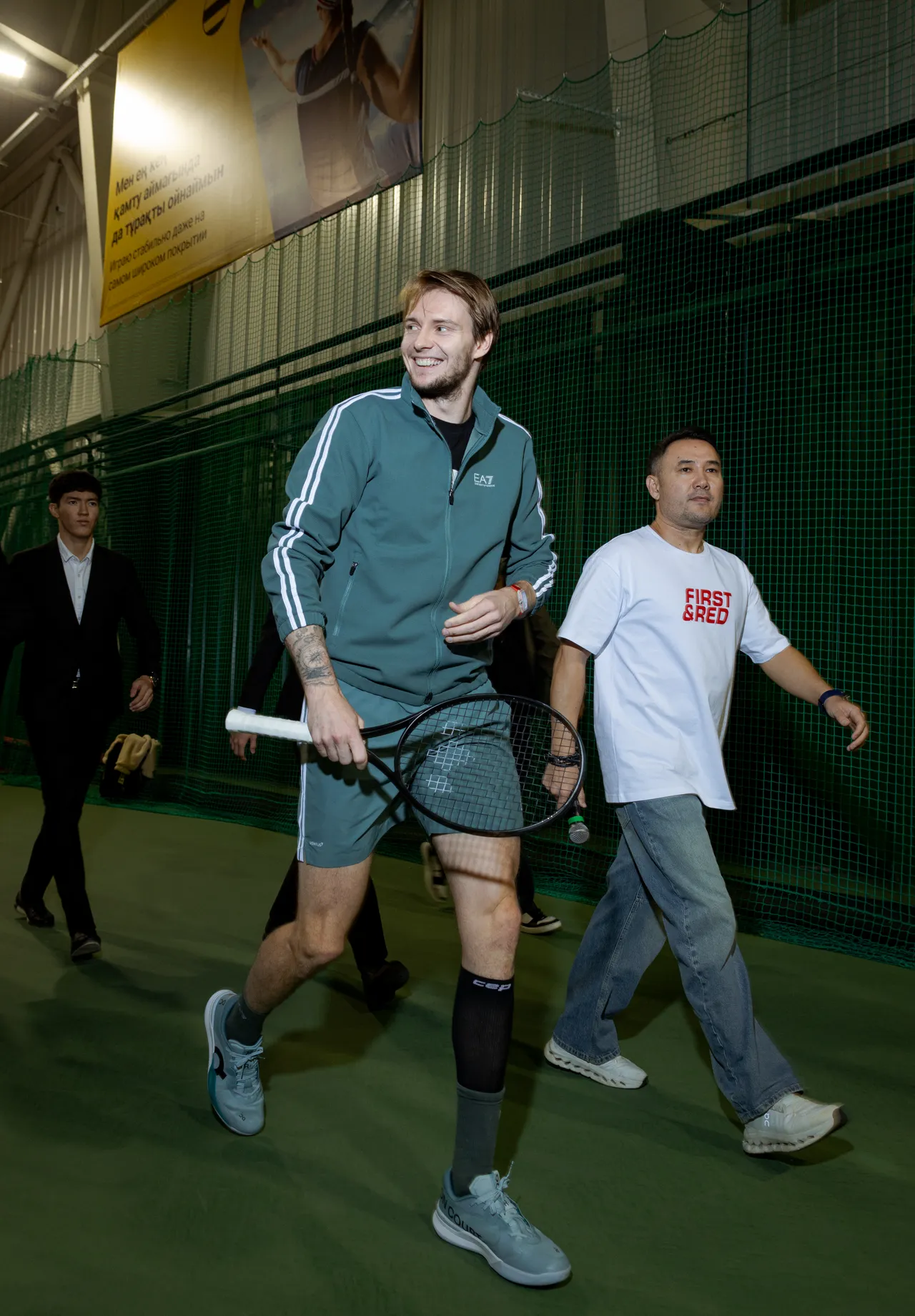
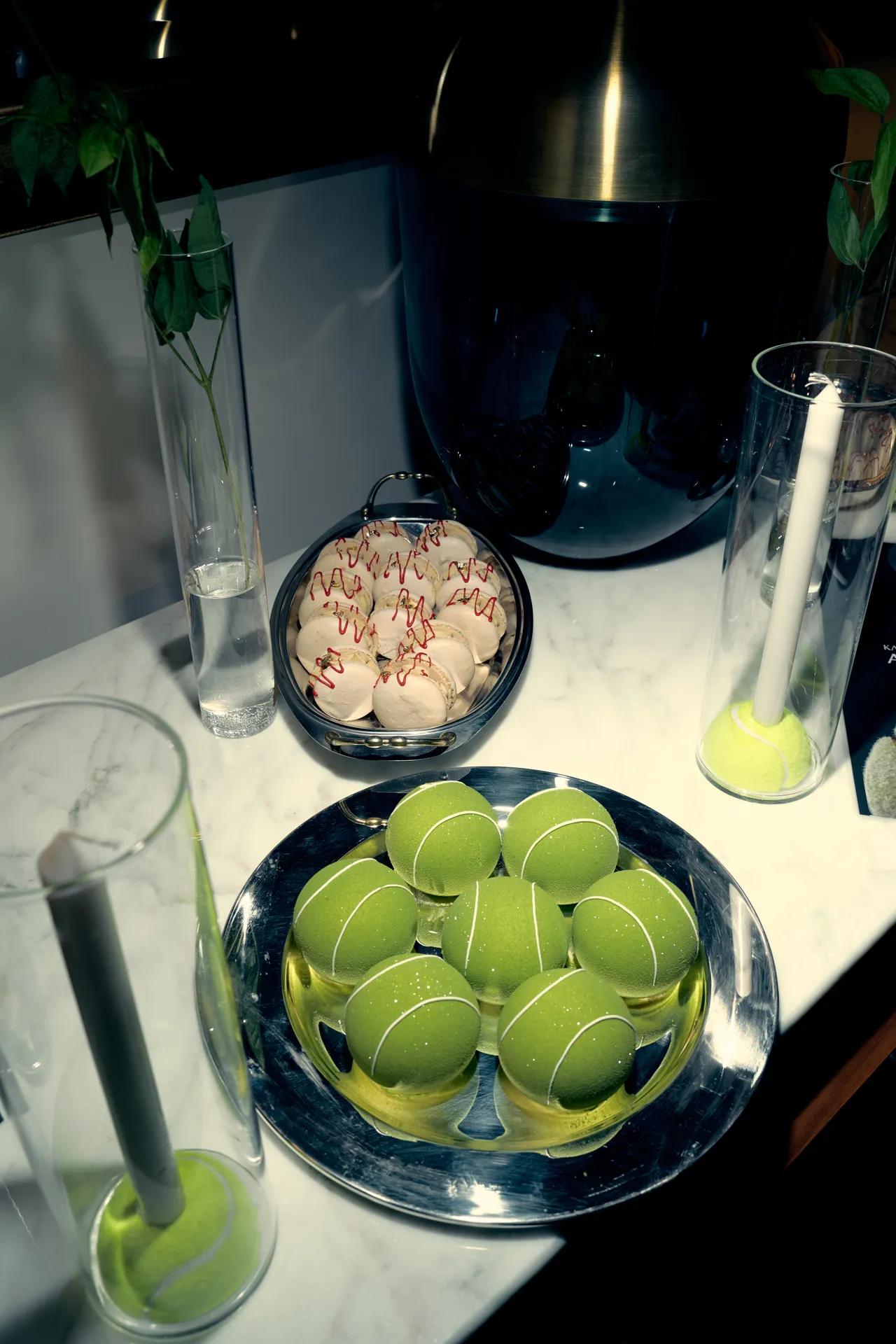
угощения на мероприятии First&RedAlexander Bublik at FONBASEKaren Khachanov at the First & Red event with fans and mediaAlexander Bublik is First&Red ambassador
All photos