Match Center
Back to videos

Chak-Chat: Anna Chakvetadze

First&Red ShowInterview

Greek player Stefanos Tsitsipas was the exclusive guest of Anna Chakvetadze on the latest episode of the Chak-Chat show.
Duration
Family friendly
Yes

Transcript

[music] Hello and welcome to the FS and Dread channel. I'm Anna Chikvitadze and today we have a special guest, tennis star Stefanascipas. Stefan, thank you for coming. Nice to see you. Thank you for the invitation. I was wondering what your family member calls you at home. You are known as Stefanas, but I have also heard Styopa and Stepan. That's right. That's what they call me from my mother's side. She sometimes calls me more affectionately, in a simpler way. Stepkin. Stepkin, yes, she likes it. So over the years I got used to this name. And when she gets angry, she sometimes calls you Stepan , yes, it happens in different ways. Many players fly to the Maldives during the off-season, but you chose something completely different, to Mibia. What is the reason for this choice? Well, adventure, you see, the Maldives is a very predictable destination for any tennis player. And the last thing I want is to do something banal. I love spontaneity. Mibia has definitely been on my wish list for a very long time. There was simply no opportunity to go there. So I really wanted to see what kind of place this was . Where else have you never been but would like to visit? There are too many of them. That's the problem. To be honest, Africa is one of those destinations that taught me a lot , especially after Namibia. Now I am making plans to travel to other African countries. Kenya would be on the list, Zambia would be included by South Africa. I also want to explore South and Central America thoroughly. I've never been to Brazil, so there are many destinations. Costa Rica is also among them. I need some free time off the court. I can't do everything at once. I want to be everywhere, but I also have a tennis career and I have to prioritize. You haven't beaten a top-20 player in quite some time, but you started this season with a win over a top- 10 player. What has changed? My back and confidence. It seems to me that all of this is interconnected. Your confidence is shattered when your body is not in good shape, when it is not in the condition you want it to be in. It is not for nothing that they say, a healthy mind resides in a healthy body . A lot of things are starting to go downhill. The trauma had a strong impact on my consciousness for six or seven months, on how I experienced negative emotions internally, and how I perceived my career. Failure to have a healthy body ultimately leads to an unhealthy state of mind. So it was very difficult to go through such a roller coaster throughout the year . And beating the best players in that particular part of the season was certainly not the main goal. I started last year pretty well. I won the tournament and felt like I was rolling like a snowball on the right path. But the further the season went, the more difficult things became. And from the moment it all started, I stopped feeling the support under my feet. I feel like I lost my balance. You finished last season in September. What did you do after that? I was just practicing. You wo n't believe it, but I trained. every single day trying to recover from the injury. I remember lying in my hotel room the morning after losing in the second round of the US Open . It was difficult for me to get out of bed. That's how bad the pain was. I remember getting into the car that night because my match ended very late. And I remember I could hardly walk. I remember thinking, what am I doing here, what am I doing in New York, what am I doing with my career. That was when the thought first came to my mind. I remember talking to my dad at that moment and telling him, "I'm not going to play until I'm 100% ready. That's where I'm leaving it." I didn't keep my promise. I still had a lot of passion and desire to play for my country in the Davis Cup. We played against Brazil, but it was more of an internal force that pushed me to make this decision. I wasn't thinking about myself, I was thinking about the team. Shortly after your loss at the US Open, people saw you playing padel at a private club in New York. How did this happen? Paddle in New York? Yes, I did play paddle in New York. Right. A few days later. Yes, exactly. The first 2 days I had a lot of trouble walking. On the third, fourth, fifth day I felt a little better. I wanted to have some fun, so I went out of town to play padel with my friends. Since you remembered, I remembered too. Believe it or not, even there I had a hard time playing Padal . I am the kind of person who is very hyperactive and doesn’t like to sit and do nothing. And when I have the opportunity to hang out with friends, play sports, I'm always for it. I'm not the kind of guy who sits on the couch and plays video games. This is not my character. Your doctor Hans Wilhelm Müller Wolfhard is very famous in the world of sports, but his methods are quite controversial. Did that make you think twice before working with him ? I only know good things about Dr. Müller. That's exactly why I chose it. I have no idea what he went through in the past. I received recommendations to contact him from the best athletes, the best people in the sports industry. Maybe from the football players? Football players. I also know that Usain Bolt chose him in a very difficult situation for himself . Many top-flight players, especially from the German national football team, which I consider one of the best in the world, trusted him with everything related to medicine. And I was simply in a critical situation. Obviously, in a case like this, I would choose the best one to try to help myself. For me, it was a completely obvious decision. How are you feeling now? It's great now. I am completely fine and do not feel any discomfort. So I owe him a lot. He helped me start winning again and finally feel like myself again . In the fall, when you finished your season, it was a bit strange to see you at the awards ceremony of the tournament in Athens. You know, it's usually for former players. Did n't you find it a little unusual yourself? I didn't plan to go on court at all. It all seemed very strange to me when I was invited. You didn't refuse. This is true. I didn't refuse. I remember sitting right behind Djokovic's bench when he played the final against Musetti. When the match was over, I thought, "I have to go, I have no place at the ceremony. I want to go home." There were bound to be some traffic jams along the way, so I wanted to get out of there as quickly as possible . I remember Djokovic calling me and saying, "Steph, come out to Cord, you have to be there. I'm not going to turn down a new Djokovic. If Djokovic wants me there, I'll be there." But, honestly, when we were standing in the photo with Novykom at the museum, I felt like I had already finished my career or something like that . All sorts of thoughts are running through my head, like, in theory, I’m still an active player. Actually, you are absolutely right. I felt like I didn't belong in that photo shoot with them. It was very strange for me. Was last season the hardest in your career? Yes, 100%. It was one of those moments and situations that puts you under extreme stress. It tests your psychological limits. Because imagine you're going from tournament to tournament and you're like, "Okay, I can play, I can definitely play this week." But a few hours before the match, you see, I won’t be able to do this. And this was repeated two or three times in a row. After I played in Saudi Arabia, I went to Vienna. I went to play. I wanted to play at Paris Bercy, but I couldn’t. And it was very painful for me to realize that my season was over. When things are going badly, what helps you not to think about it? Reminding myself that I am a good person and have done a lot of good without doing anything bad to anyone. I don't harm anyone. I have no bad intentions against anyone. And it reminds me, you know, bad things are going to happen to you, but you have to be brave and face them head on . I have good intentions towards other people and I honestly don't wish harm on anyone, so I feel like that's my driving force every day. If something comes back to me like a boomerang, I try to deal with it by remaining silent and calm. and without reacting in any way. And in a recent interview, your mother said that only Alcaraz and Sinor have a chance of winning Grand Slam tournaments. Do you agree with her? I think there are a lot of players who can win Grand Slam tournaments, not just Carls and Janik. Although these guys have shown phenomenal consistency in the last couple of summers, they have been in almost every final. My mom talks like she played against one of them. In fact, she is simply judging from the outside, based on her experience. I believe that there are other candidates to win the majors. I don't think it's just Yanik and Carls. Who, for example? Are you on the list? I do n't know if I'm on this list. If I 'm healthy, then maybe yes. And I wouldn't play Grand Slam tournaments if I thought I couldn't win them. I would have finished yesterday. I think there are a lot of great talented players who have a good chance of winning a tournament like this. Who can I name? Well, Alexander Zverev came very close several times. Of course, there are a few areas in his game that, if improved, he could get even closer to the limit. I think he is a great candidate for the Grand Slam title. You know, Lorenz Musetti has been showing great progress in his game lately. I saw him in person and I see he has improved a lot . I think if he continues in the same spirit, he will also be a candidate for the series title. Even though people say his beloved one-handed backhand is a weakness in modern tennis, I still believe he is capable. Have your goals changed since you joined the tour? Rather, they adapted. My goals have adapted since I started touring. When you start out on tour as a young guy, you have all these crazy dreams and ideas about yourself that you're going to change the world with your tennis, but once you get a little settled in, you see a more realistic picture and the real situation. Everyday tennis grounded me. Tennis has certainly become for me, first and foremost, something that cultivates internal discipline. By this I mean that he helped me understand my strengths and weaknesses not only as a player, but also as an individual, as a person. I've made mistakes on and off the court , and I would say that's absolutely normal. This in itself is not a weakness, it is a certain transformation, a change that you are going through. I think it's necessary, and most importantly, very important, for my career to go through those perhaps stupid moments that happened in the past, rethink them, and ask myself, "How can I do better next time?" Tennis has allowed me to dream, and my goals today are different than they were when I started playing in terms of how I approach my daily routine and how I train. And what is your main goal? My main goal is to be healthy for the whole year and maybe reach a Grand Slam final again. And in the final of a major, you never know what might happen. Your mom said she could help you become better if your team let her. Why isn't she participating anymore? My mother is very passionate about the game. She loves me very much and wants only the best for me. But, unfortunately, it is unstable in terms of daily presence. It comes from feelings. She has a lot of feelings and emotions. I love her to death. She is my favorite person in the world. She has really helped me a lot in the past, but unfortunately, at her age and in her situation, it is not easy to travel with me all year round. And I think I already have enough family members on my team. I think that would be too much. I remember how many years ago she came to your press conference and said that children should be grateful to their parents for the fact that they pay such increased attention, as many people think, to their careers. And you reacted with humor and asked her which player won a Grand Slam tournament in this way? [laughter] Has your attitude towards parental care changed? I'm trying to remember who won. It's much easier for me and my parents now, you know? I remember that this was a stage when I was still developing. I guess I wished my parents were a little further away. And I was in a different phase than I am now. Now it doesn't bother me at all . And what changes? I definitely know how to communicate with them better than I did 5 years ago. I just grew up. I guess I started to see my parents more as part of my team and my daily life, rather than wanting to distance myself from them and do things my way . So my attitude towards this matter has changed. I see them in a completely different light than I did then. And I don't think they want to harm me. They just love the game with such a passion. They want to help me and they just can't live without tennis. They need tennis in their lives. But if they want it in life, they will have to cooperate with me and work together. Has the break from working with your father affected the way you work together now? Of course, that break with my father really helped me understand his view of me as a person and how I see him, what exactly prevents us from working together. There are a lot of emotions involved in such relationships . The relationship between father and son is not easy. And over time, tension can build up in them. I still need some space from my dad sometimes. And I still find it helpful to have weeks a year where I 'll work with a different coach, the same one I worked with a few months ago, and have him at tournaments where I feel like I need him. This will be useful for us in terms of further development of my career. This will help us build closer relationships and achieve better communication. What hurt us the most was that at some point we were not on the same page, we didn't communicate well, and ultimately it created more friction than connection. But you need a connection to perform on the court and have a clear daily routine. My life is spent on the court. I can't talk to someone and try to explain something I see if they don't want to listen. You know, it’s important to have someone nearby who can listen, who can understand what you want to say, and not just broadcast it themselves. Your mother was a professional tennis player, your father was not. Why do you feel more comfortable entrusting the role of coach to your father? My father, and I'm sure my mother would agree, is much more persistent than she is. In terms of discipline, he is able to convey his thoughts and devote himself completely to the task. My mother, unfortunately, does not have this ability. She is a very smart coach and has great ideas. She has a wealth of wisdom to share regarding the game. But she is not the kind of person who will insist and do all those little things that are required of a coach for a player to progress. I would compare my mother to a creative director and my father to a producer. That is, my father is a producer, and my mother is the creative director of this enterprise, this business. Could you tell us a little about your father's background and how he became a tennis coach? He started out at the Sports University in Athens and chose tennis as his focus. There he met my first tennis coach, who taught me how to play correctly and developed my technique from childhood . There they met, and my father chose tennis as his direction, his sport. fell in love with him. Dad comes from a very small village in central Greece. He and his brother played with homemade rackets on a homemade court. He was fascinated by Björn Borg and John McEnroe and dreamed of one day playing real tennis. But he played, he didn't play professionally, he learned at a very late age. I think he was 23 years old when he learned to play. Honestly, the way he's playing today, for someone who learned at 23, I'm quite impressed. So he's pretty good. Yes, of course, it is surprising, because you don’t expect that a person who started studying so late will be able to develop such skills. My father has great leadership qualities, he likes it. I do n't mean this in any bad or negative way. He is not expected to know all the professional subtleties. That's what my mom is for. She has that same professional tennis intelligence, the kind that is developed over years of seeing these schemes, playing according to these schemes, playing against these opponents. You can recognize moments. My father comes from a more amateur tennis background, but he has an amazing coaching eye. He looks at things from a coaching perspective. And I think the two of them complement each other very well . You worked with different coaches: Patrick Murataglou, Goron Ivanisevic, coaches with completely different styles, approaches and experience. How would you describe their methods and why do you think they didn't work? Their approaches to work are very different because they are completely different. One of them is direct and blunt , the other is positive. So it didn't work. You know, working with coaches and former tennis players is great because you can get into their heads and understand their understanding of the game. This has always fascinated me. It kind of gives you a whole different feel for tennis. I worked with Mark Philippoussis for a while. I learned a lot from him and I don't owe him much because he really improved my game. Did you communicate with each other in Greek? Yes, he is of Greek descent, so he speaks Greek. We parted ways, but I'm still very grateful to him because he taught me a lot, especially my aggressive side of the game, which I try to use against any opponent. We worked a lot on volleys with him and it helped me a lot. With Goron, everything was different. When I started working with him, I didn't know him very well. I probably said hello to him a couple of times in the past when he worked with Novak Djokovic. I spent some time getting to know him, and after a couple of weeks I didn't feel any synergy between us. Even if you force yourself, if you want it to work, sometimes it just doesn't work. There is no explanation for such a collision. The way we communicated, the style of training, I felt that it was not at all what I was looking for, not what was needed at that moment. And that was also the reason why I broke up with him so early. This was never in my plans. But when you see no results, it’s hard not to go against your own feelings. Were you offended by his comments about your game? He was probably right about some things, but it was a very strange time to make such statements. Because at that particular time I was going through a very difficult time because of my back. And to say things like that, I felt like it was very unfair to me because I didn't have the opportunity to train properly. My back hurt constantly. I remember going to training and just couldn't do it properly because of the pain. I think we only had one or two full training sessions where I could really show myself and my true potential. So it was a very strange time for comments of this kind . After all, we were together for such a short time that he simply didn’t have time to get to know me properly. In total, we spent less than 15 hours on the court. And the reason I hire a coach like Goren is to progress and improve my game, not to sit back and do nothing. Otherwise, I could have done it with any other, much cheaper mentor. When I pay a coach good money for his work , I really want to give it my all and work hard. And that's part of the deal. I'm ready for this. What is most Russian about you? What is most Russian about me? I love luxury, I guess. Don't know. I appreciate and love luxury. This is perhaps the most Russian thing about me. How would you describe the Russian character? Russians are quite aloof, but if you've already become a friend inside, then you're really one of them. This is exactly who I am. Do you follow Russian culture? Through films, books, music? Music, movies and some travel videos on YouTube. Which films exactly? Drama films. I don't know what they're called, but I've been watching them a lot over the last couple of years. I do n't remember the names. Don't ask. And of course, you have strong Greek roots, and your posts on social media often look like works of art. Do you have a favorite philosopher? In general, I admire all ancient philosophers and think they did great things. I feel somewhat responsible for introducing people to my culture. I am proud to be a sin. I am proud to come from the place that invented democracy and gave the world so many wonderful things we can enjoy today. I can help people understand Greece better and do it through tennis. You had difficult moments with Medvedev and Rublev. The attitude is better now. Absolutely. I have no complaints about them. I appreciate their unique, unlived nature. I'm a big fan of Andrey's game. I think we can learn a lot from him in terms of how devastating you can be during a game. Andrey is one of the most difficult opponents I have ever faced. Especially when he's on fire. It's hard to defend against him. He has one of the fastest shots on tour. Can you name Daniil Medvedev's three best qualities ? I would say his ability to never give up is impressive. I've seen him in moments when nothing is working, and he's still able to pick himself up, put the puzzle together, and make it work. To be honest, I'm impressed by how he manages to beat Forehand with such a specific move. This is an amazing skill. Amazing skill. This is where I take my hat off. I'm impressed, you see, I spent countless hours as a kid with my coach, honing my technique and getting it as pure as possible. And when I see that, I'm like, "You know what? I applaud you. You make it work. I don't know how. I could never make it work. He's got one of the best back ends on tour, especially when the ball goes behind his body. It's something out of hockey. Could you say a few words in Russian on camera for our fans? What exactly do you want me to say? Maybe some advice then? Don't wait for your chance. Create it. I'm Stefan Stipa. Watch First and Red. Thank you and all the best. [music] Yeah.

No comments yet.

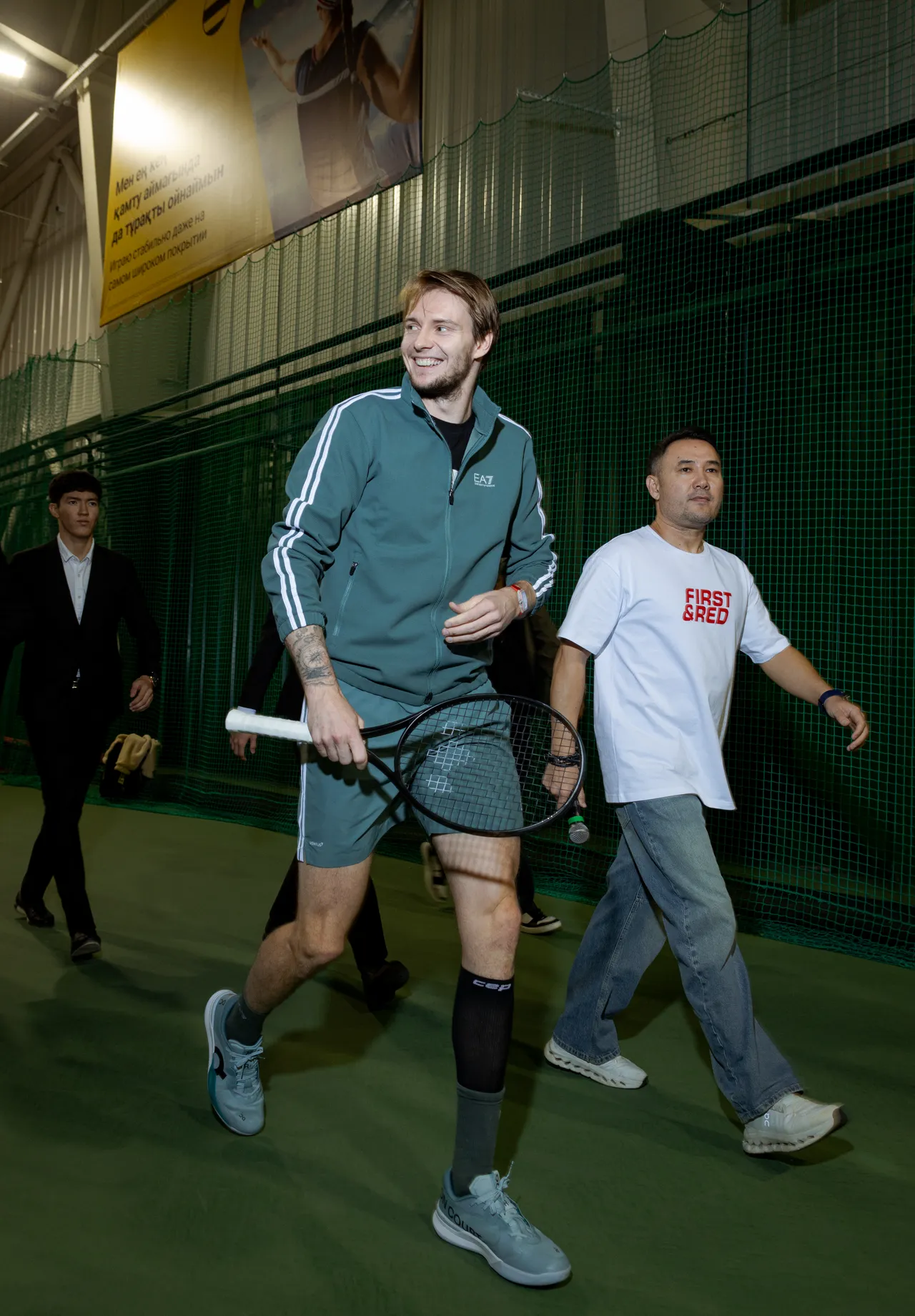
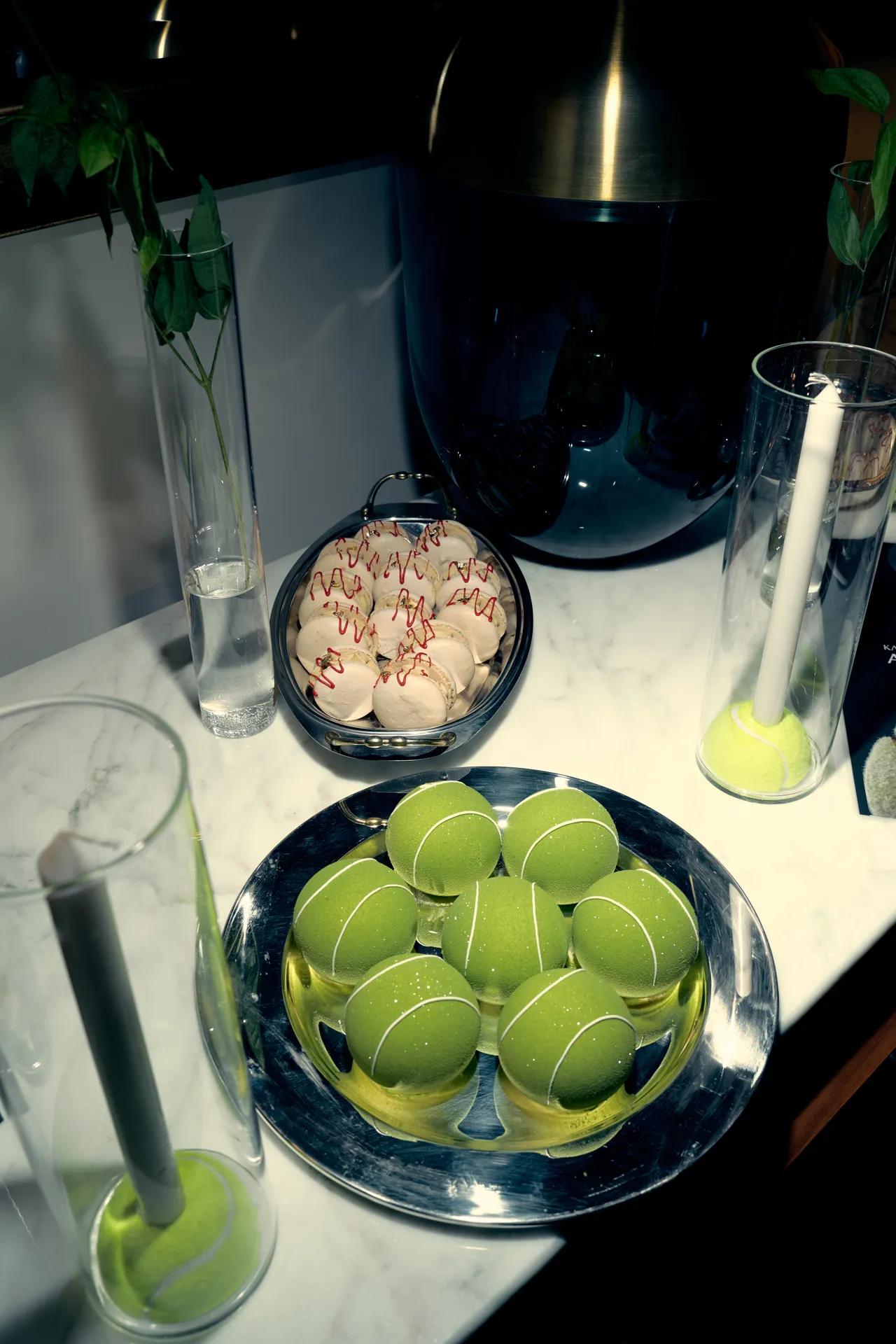
угощения на мероприятии First&RedAlexander Bublik at FONBASEKaren Khachanov at the First & Red event with fans and mediaAlexander Bublik is First&Red ambassador
All photos