Match Center
Back to videos

Alexander Bublik: victory over Sinner, the title in Halle, and working with Safin

First&Red ShowInterview

Alexander Bublik is having the best stretch of his career and is making a strong impression on the entire tennis tour.
Duration
Family friendly
Yes

Transcript

[music] Hello everyone. You are on the First and Red channel. And once again our guest is Alexander Bublik. Sasha, you just won the title. We congratulate you. Tell me what means more to you : reaching the quarter-finals of the Rolangaros for the first time or winning the title in Halés for the second time? These are probably slightly different things, because after all, a title is a story. The title adds one more unit. in the titles column, yes, let's say so. But still , probably in terms of significance for me personally, I think that the title is still more significant. But since I had never reached a Grand Slam quarter-final before , the Grand Slam quarter-final was more memorable to me than the Hull victory because I had already won there. At the awards ceremony, you and Daniya doused each other with champagne. You even took a little sip, but it seems that this was only the beginning of the fun. Was there a sequel? No, there was no particular continuation that day . After all, I’m not a young man anymore, and it’s not as easy for me to hang out after matches like this as it used to be. So no, we sat, drank, had a snack, had a bite and went to bed. The next day we were already leaving for London. And in the evening, the team and I went to a restaurant in London. And so we sat for a little while, yes, there was nothing more than something natural. Did you talk to Dane after the finale? No, we saw each other only closer to the night, when they, I think, were playing cards with Karen, and we were sitting with Artyom, also playing cards. And then they exchanged a few phrases. They flew to London in the morning, and I travelled by train during the day. What did you play? A fool, probably. I don't know what they were playing. What did you play? As a fool. For money. There is no money. There's nothing to play for. Before the final, you said that Medvedev was one of the few players you hadn’t yet managed to beat. It looks like you're coming out to the match especially charged up, just like in the matches with Rublev and Khachanov. Do you feel extra motivation in matches against Russian players? I think yes, of course, after all, I grew up with them. I went through the whole tennis path with them, roughly speaking, from the very beginning until, roughly speaking, Dania was number one in the world, all the guys there were in the top ten, I was seventeenth. That is, it is a lifelong path, I guess. And, of course, when you play with them, in any case there are some memories, some, probably some desire to beat someone. For example, I never beat Kore, I never beat him, I never beat Dan. Karen had only been played once before on a building. That was such a difficult personal story. Therefore, yes, of course, in terms of, probably, for everything, for Russia, for Kazakhstan, for the entire post-Soviet space, these matches generate more interest when two compatriots meet, or, let's say, those you, in my case, yes, I transferred, but still, as a Russian person, I grew up with them, yes, so, probably, these matches generate more interest. Well, and probably from our side, at least from mine, it’s definitely much more interesting for me and somewhere, perhaps, more exciting to play. After Rolangaros you said that Sinor is better than you in everything, after defeating him you felt that Sinor is better than me in everything. Well, you beat him. Didn't you feel that you could also be top, since you beat him? Well, what do we call top? What rating level is this ? Well, what is he on? No, well you said that I can be top. When you say this, what do you mean ? How does it usually work? That is, if you usually beat the world's number one tennis player, yes, well, thoughts like this might arise , but he's not that great after all. It seems to me that tennis is a sport in which, if Vasya beat Petya, and Petya beat Seryozha, it doesn't mean that Vasya will beat Seryozha. For some reason, it seems to me that in tennis it doesn’t work that way. That is, everything is completely the opposite in tennis. Well, let's get back to talking about the top. What does top mean in your understanding, in the form of not me? Well, let's say he is the world's number one tennis player. You beat him. Don't you feel like you can play at this level all the time? Or play at the level of the world's number one tennis player? But it seems to me, it seems to me that if after the victory over Siner I felt that I could play at the level of the world's number one tennis player, and therefore become one, we could go to the dispensary together. Well, well, because it's funny, sort of. This is one tennis match - this is the distance. That is, a tennis player who played at the top-10 level for one year and then ended his career is not a top-10 tennis player in my understanding. So you think he was out of shape? I didn't say that. I believe that one individual match cannot be taken as a system. That is, yes, in a single match, in that condition, I was able to show excellent tennis and take advantage of what he gave me. Yes. I don't know if I'll be able to do it next week, but based on statistics, I probably won't be able to. But to beat once, that is, of course, yes, why not. and Feder lost to God knows who, and Nadal, and everyone, everyone, all the great people, yes. But tennis is simply about consistency, tennis is about repeating your results. That is, roughly speaking, there, well, for example, we often have this happen there in the team, there among our close friends, they ask me there, is someone a good league player . I say: "No, why? He was in the top ten, I say." So, he was there once and then ended his career after a year and a half. So for me, tennis is about repeating results. Well, at least, well, let's say this, five or six seasons in a row, so that a person is there, then we can say that he has this level there. That is, roughly speaking, there, well, if we, I don’t know, take some example, I don’t know, let’s say, Jack, Jack’s first season entered the top five. If he confirms this next year, and then confirms it again, then we can call him a top five player. That is, and what, for example, Holger did there with the runes, well, for example, yes, that’s the closest example for you. He came in fourth and after, I think, six months or a year, he was already eliminated. That is, no one in the tennis world considers him a top five player. This is , perhaps, the essence of tennis, that, yes, if I now played Rolangaros, I confirmed, so to speak, my result at Rolangaros with the result in Hal, but then I have Wimbledon, after Wimbledon I have the Masters, after the Masters I have the Grand Slam. That is, if I can, well, let's at least do it this way, well, honestly, put my hands to myself, yes, play for six months at this level, then we can talk about something, about whether a donut can stand there, I don't know, eighth, fifth, sixth, right? And years from now, we'll only be able to talk about whether Bublik can become number one, because this path is decades long, yes, just like if we look at the path of the same Siner, who was ninth in 23, in 24, but only became three for the first time , that is, he, well, his first slam semi-final was in 23 after he didn't lose in Hal. That is, if the path is so long for such people, then what can we say about, roughly speaking, an ordinary athlete like me, right? I mean, yes, I can play tennis, but I'm not Siner or Alcaraz. That is why, perhaps, you still need to keep your feet on the ground, yes, and not believe that you are now the best in the world, the most beautiful and golden, but continue to work and try to confirm and gain results, so to speak. And thus it will be possible to see, yes, how I will stand at the end of the year, how I will stand there in the middle of the next. And then we will be able to draw conclusions about whether something has changed inside me there with Rolangaros, yes, with such a big result and what I have come to, say, by Rolangaros next year. For example, if I were, I don’t know, in the 12th seed, in the 16th seed at the next Rolangaros, then we’d be able to talk about something, because after all, a year had already passed . Yes, you played in the Challengers this year. How difficult was it psychologically to return to such competitions after big tournaments? Well, I haven't played challengers that were really challengers, you know, those 50. After all, those were challengers that are between two masters. And the lineup there was such that, with a rating of 60, I was seeded eighth. That is, probably, these challengers are not 200, they are like 250s, that is, in terms of composition. Well, well, I didn’t live, for example, in an official hotel, because it was bad. Well, that was probably the only thing that made the situation different. That is, yes, like, uh, probably, even it helped me to some extent, because I finally stopped playing on a regular basis with top twenty and top ten players in the first rounds, since I had, yes, I had Mbert, Felix, Rublev there, that is, it was all in a row. And of course it wasn't easy, especially when you lose. And having returned there, sort of, for the challengers, you could even say, between tournaments, yes, that is, I played the Masters and between the Masters I played the Challenger in the second week, it helped me get a certain number of matches, win a certain number of matches and feel victorious again, yes, it’s like getting used to losses, the worst thing, probably, that can happen to any Tennessee player is to start getting used to losses and treat them like, well, yes, well, I lost and what not, that is, it’s very much getting used to, getting used to losing in general is absolutely impossible under any circumstances. That is, the Challenger helped in this case, because I simply didn’t meet a top-20 player in the first round . And it seemed like this somewhere showed me that the problem was somewhere, clearly, in me, but in general, if I play with guys who are worth 50-60, I basically get through it calmly. And then, like, great results happened, yes, that is, but, probably, the path began right there, because I again started playing with guys who were head and shoulders above me. I started to win them, I started to believe more, to trust my shots. And that's how it turned out. That is, I didn’t really want to, as if I probably wouldn’t even go to the Challenger 50 plus H, yes, there’s some kind of or whatever they call it, 75. That is, somewhere around there for a victory there, yes, there you win four matches, you get 25 points. This is probably what is difficult in the case of this challenger, yes. Well, last year he won the pro tournament there , now he is fifth there Fis. That is, well, such challengers, well, it’s doubtful, I would say, yes, to call them challengers, but if there were more of them, let’s say, such challengers, then more of them, guys, would play from the top twenty, thirty, because you see, I won Turin there, I lost one set there. That is, as if 175 points is more than for the ATP final and 250. And try to reach the final of the 250, yes, that's also how it is, if we talk about some players who have been there in the 50 for 5-7 years, two finals in their career. That is a huge number of points. And, of course, how it would help with confidence, yes, with faith not so much in the game, but in the shots. That is, like, specifically, that I can put the ball where I want, because I’m not under so much pressure. That is, I have more time, I have more time to make a decision. And then , when I was already playing against stronger guys there, yes, in Madrid there against there, I played with Mechuk and with Popyrin, and with Andrey, that is, I played with Ruud, and with Roma Sofyun, that is, in any case, there was less time, since these are higher-class players, but still, some instincts remain from the fact that I was playing now, I got used to it and it was easier for me. That is, of course, of course , it helped. So I look at it as a positive. And even when I was 80, I looked at it as a positive thing, because I was saying that if I still had a level, that is, I didn’t know, I was like, well, I’m not Nostradamus, I can’t know in advance what will happen. And I thought, "Okay, if I have it, if I have a level, then challenges shouldn't be a big deal." That is, if, of course, I don’t get there, all the same, Borgos played there, he’s worth 30, Kaboli played there, he’s worth 20, yes, there are, roughly speaking, a lot of guys there. And deep down I kind of hoped that my level had remained the same. It's just that , well, I lost a match that I had never lost before due to various reasons, and it just so happened that I was simply stronger in the Challengers than those guys. And I simply confirmed this level and then made a leap, as if already at the main tournaments. You said that the trip to Vegas helped you. Var. Why are you so hung up on this trip ? What a horror. Well, this is interesting. So what happened there? And nothing happened there. The same thing that remains in Vegas. Yes. Yes. No, no . I am a married man, a deeply married man. Vegas. I sat modestly, rested modestly. There's nothing here. Look, it's nothing. I went to bed in London later than I went to bed in Vegas. I'm telling you, I'm an old, old, even a little bit aged man. You are one of the few tennis players who did not change teams during difficult times. Tell me why? Very good question, very interesting. It turns out that, like me and my team, I actually had two coaches in my life. Well, let's make it three . It was my father Boris Lvovich Sopkin and Artyom Suprunov. That is, I worked with one from childhood until I was 20 years old, roughly speaking, the other helped me and helps me to this day. And the third one sacrificed everything he had, roughly speaking, there, including his hobbies, his life at home, and to some extent, probably his family and time with the children, in order to work with me, ah, well, I guess it would be said for pennies initially, because initially, well, I won’t say it , but the money I paid Artyom at that time was absolutely ridiculous, because that’s what we agreed on. And, probably, after so many years, having found myself, after so many years at the top, yes, that is, I was in the top 30 with Artem, starting in 2020, in 2021, after so many years, in a difficult moment, to say: “Yeah, go to hell, yeah, and I’ll go look for some coach who did nothing to, uh, put me at the rating I was at, yeah, and help me achieve, yeah, some successes that I never achieved. This is probably wrong. But we had a moment when Artem himself wanted to leave. Ah, well, he thought that he couldn’t help me anymore. And he and I had a conversation, he told me that I don’t know how to help you. We probably need to change something, we probably need to look for someone. But I don’t like that. And, well, we had a lot of arguments. I kind of, well, even probably raised my voice somewhere . We had a lot of that with him. We argued about this. And I'm saying that, like, well, you can't leave. I'm saying that I say, "Imagine how great it will be if we go back to where we were from there. And thankfully he heard me." I mean, our last conversation like that was in Rome, that is, like that, that is, like he was getting ready to fly away. I, well, I mean, I told him some things, yeah, like my opinion on the situation. The main point was, yeah, what I was saying was: "You understand, like, well, you always have time to leave." I mean, well, absolutely always. I mean, yeah, well , I mean, not because he wanted to tell me to go to hell, because he probably didn't see. Well, you need to ask him too , he probably didn't see how he could help me and why I was losing. I mean, like, I was losing 64 in the third round. Well, what are you going to tell me? I lost to a guy who played two finals. What are you going to tell me? Why did I lose? Because I didn't hit my forehand on breakpoint at nine. Well, that's the kind of thing that matters, yeah. And he probably didn't see how he could help me, But somewhere, well, I mean, I got stubborn with my character, I started using some nasty words, yeah, which maybe hurt him somewhere, ah, and got him going. And after Rome, he kind of turned into a completely different person in terms of the process, in terms of the things he ever said to me or didn't say. I mean, and after Khali , when we were hugging, I said to him, I say: "I told you, I tell you that you can't leave." I mean, well, because, well, it wouldn't have worked out for us, well, he would have left later. Well, okay, well, he always has time to throw it in the car. Well, we roughly understood what words you found for Artyom. Well, of course, of course, of course. I mean, the most important thing is that the most important thing is that we heard each other and got through it. I mean, well, I mean, I can say that we're back to where we were. I mean, from now on, it's up to us. I mean, we're back to where we started the year. We started '32. I I started the year in '32 or '33, and now it's '30.' So the question is: will we take the next step, or will we roll back? If we don't take the next step , then rolling back is simply inevitable. So that's why it's like that . Is it true that you had a trial period with Marat Safin, and it lasted a week? We were in touch—Artem and I, that is, Artem is an open person in this regard , for which he deserves a lot of respect, so to speak. He himself came and said: "Listen, it seems to me—I mean, I've always had problems with big tournaments, I guess I still do." Oh, I mean, I never played well at the Masters, I never played well at the Slams. For me, it was always, well, these two-week formats, they always sucked a lot of energy out of me . It's always hard for me because you're playing at 11:00 in the morning in the heat, then you're playing at 9:00 in the evening, then you're playing at 11:00 in the morning again. I'm kind of going crazy. That is to say, it’s really hard for me to adapt like that. And that is, to this day, as it were, that is, even here, well, here is the match of Sminor 6262, yes, that is, even in the form in which I was 6262 at 11:00 in the morning. That is, because before that I played at 8:00 pm or 6:00 pm. That is, for me, it’s just really hard. That is to say, I don’t know what to do with this. That is, even if you wake me up at 6:00 in the morning , I still do n’t understand how to play in training at 11:00 in the morning. Even if I train the entire pre-season at 10:30, I can’t play matches in Australia at 11 am . That is, I go to the core as if my hands weren’t mine. Here. And Artyom says: “Well, we need someone who can explain what we’re doing wrong.” That is, well, it’s always better when a person, well, another pair of eyes, so to speak, points out to you that look, you’re doing this, this, this incorrectly. And we thought about who could, in theory, suit us. Well, that is, based on my character, based on what I want. I mean, you know, you can't just come and say, "I want to be coached." He will say: "What do you want?" Yes, there, and I’ll say: “I want this.” He will say: "I don't want this." That is, well, these swings of sorts begin. And, probably, among all the Russian-speaking guys who were, yes, from the legends of that time, yes, we have there Kolya Davydenko, Misha Yuzhny, Marat, that is, well, those are the main ones, yes, so to speak, probably. And we were like, "Why not contact Marat?" Well, in the end they looked for his phone number for some time , found it, contacted him, and talked for probably, maybe, a week. I mean, well, I was like, well, I was told some things that he saw would help me, uh, play better. But then we had a moment when he asked me what I wanted, and I said that basically I just wanted to play tennis and stand there, well, where I stand, yes. I like to be around twenty. I really like this place . It probably doesn't require so many emotions and nerves, yes, it does n't waste so many emotions and nerves, because my level allows me to stand there. And he honestly told me that he couldn’t help me with this. That is, like , probably, that is, we had a period of 10 days there, where we discussed everything over the phone. He even said some things that need to be trained, which he saw, yes, why I lose some matches. Well, this is a champion, you know. The most important thing is that this is the head of a champion. This is a man who is, well , the greatest, yes, probably, tennis player in Russia who ever lived. And it’s a little unclear to me. That is, I understand why he thinks this way, but for me, as a more or less simple athlete, it’s a little unclear to me. And I even felt a bit, well, uncomfortable when he told me something . And I kind of understand that I’m not even interested in this in terms of, that is, the result, that is, I’m not so excited by the thought of winning there at the Slam, yes, based on what needs to be done for this, yes, that is, I always have these certain scales, yes, that is, here is the result, what needs to be done for this . But the champion's brain, yeah, the one who achieved this, he doesn't see, he didn't say: "This is how it should be, you prepare like this and like that, you don't need these tournaments, you need these ones." I say: "And Marat, what if I prepare like this and lose at important tournaments? Go, you're an [ __ ]," he says. Well, basically, he's right. That is, like, well , I’m like, well, he’s right, but for me, as I say, as a more or less simple athlete, that is, my head doesn’t work like that, it was a little difficult for me. And we had a kind of absolute talk, and he told me: "Sasha, honestly, I can't help you, because I know how to be number one in the world. I know what it takes. I know how to train, how to approach everything. But if you don't want that, you want to be number fifteen there, then, well, why the hell do you need that? He asked me something like, like, money, well, great. Well, okay. That is, like, well, he's a champion, that is, like, I don't have any, you know, you can't say that he's somehow bad or good. No, he's just a champion who sees things differently. And then, after a while, I talked to other champions, players of the same caliber, there's STN, for example, yes, it's the same thing. That is, they have no other path. That is, this is exactly why they became Grand Slam champions and were number one in the world, number two in the world, because they have a completely different mindset. That There is and it just didn't work out for us, uh, absolutely honestly, absolutely, like, well, on a human level. He told me about it, and I completely accepted it. And that's it. At that point, we kind of stopped even trying. And like, that's when we saw each other for the first time after that , that's when he started working with Andrey . Sasha, you were seeded before. How do you perceive this status? Is it just a number next to your name or is there something more to you? Well, I've been seeded a bunch of times already, so I guess it's normal. That is, as I'm saying, we're back where we were. Back to normal. That is, I'm back where I was. That is, I finished there, I finished the year between 30 and 40 for the last six years. That is, since 2020, I think, I've finished 33, 35, 34, 32. I've never been higher or lower at the end of the year. That is, this is, basically, my position in which I I've been there for, let's say, three or four years, yes. And basically, nothing, that is, nothing special, that is, I, roughly speaking, played my two best results, and only returned to where I was. That is why I say, the next step is already ours. And about Seynov, well, yes, it's good that I don't play in the first round with some top player, a snorer, for example. Yes. That is, of course, everyone is playing tennis well now, but it's good that this way, maybe it will be a little easier. Maybe. You saw the draw or not and you can comment. [music] Yeah, listen, tennis is a sport that whether you comment or not, every tournament the top players lose, there are even some strange guys who play something, and sometimes those you don't expect play poorly, those you expect play poorly, those you don't expect play well, like me at Rogaros, yeah, Especially on grass, yes, especially here, well, I mean, discussing it, well, I think there's just no point. The level of the top 100 is the highest, and everyone can play tennis. And the Argentines have already learned to, uh, serve flat, you know, and run to the net. I mean, it's not like this is 1918, and certainly not 1922, yes, when if an Argentine, he only served kicks and threw to the halfcourt. I mean, tennis is different now, and there, let's say I have a Spaniard in the first round, but this is not the Spain that was in Almagro's time. I mean, he still hits, he still plays, and he knows how to hold his serve . I mean, he hit, too. Well, why don't you mention him at all? I'm talking about their time. I just brought up the Spaniard, who, well, didn't give it a chance. I mean, back then , of course, they were Spaniards, They dominated more on clay than on grass, yes. You can see so many results there. Now, of course, it's a little different. And everyone can play, unfortunately, yes. It was better before, and so we need to try to work on it. Sasha, thank you very much for the interesting conversation. We wish you good luck in Nabaldone and in the next tournaments. Thank you. That's it. Thank you. [music]

No comments yet.

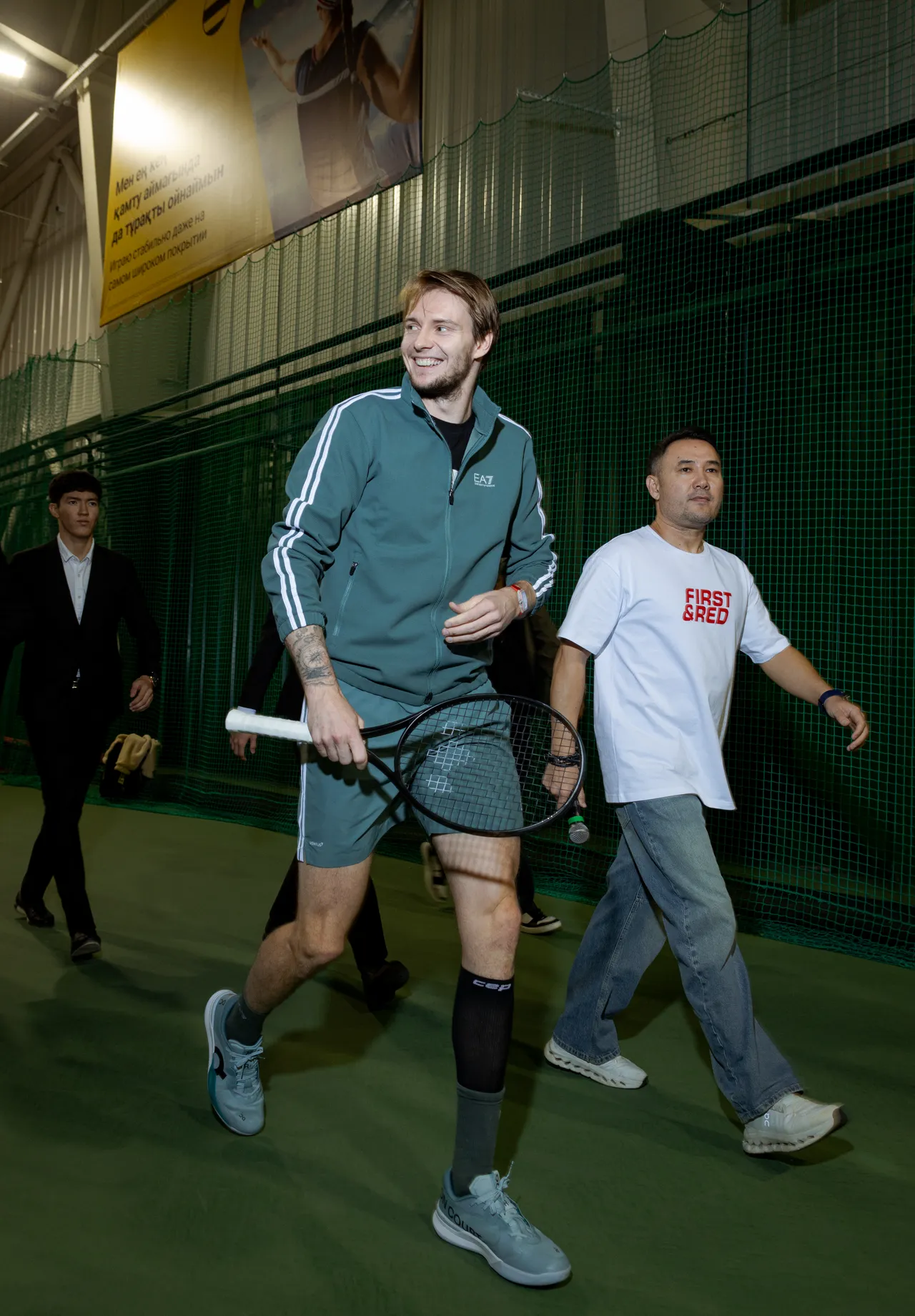
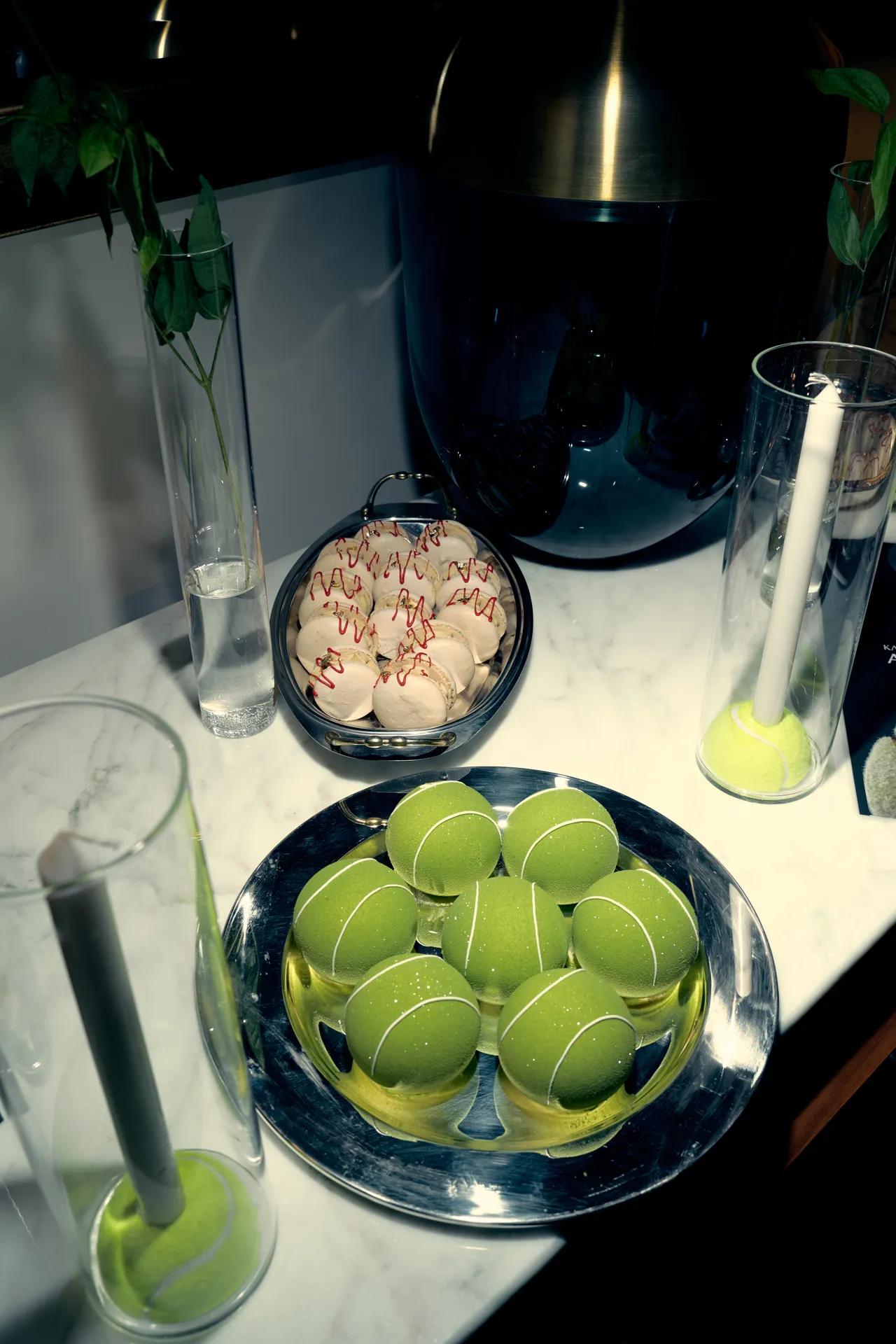
угощения на мероприятии First&RedAlexander Bublik at FONBASEKaren Khachanov at the First & Red event with fans and mediaAlexander Bublik is First&Red ambassador
All photos